
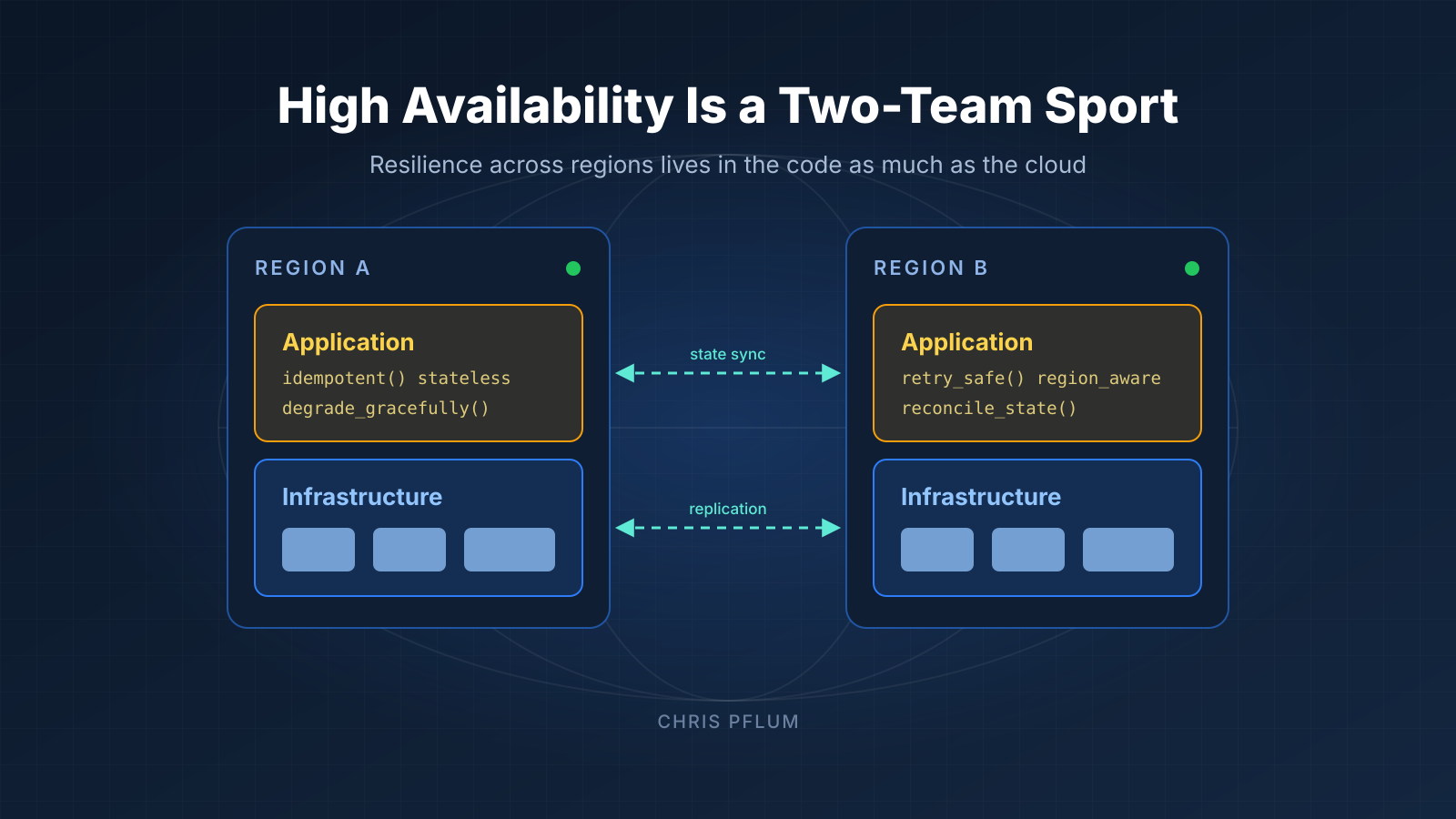
In financial services, “the platform is multi-region” is one of the most reassuring and most misleading sentences you can hear in an architecture review. I’ve sat in many of them. The cloud infrastructure team has done its job: two regions, replicated networking, global load balancing, and infrastructure as code that can stand up an environment on demand.
Then a regional event hits, traffic shifts, and the application falls over anyway.
The reason is simple. Resilience is not something infrastructure can bolt onto software after the fact. It is a property of the whole system, and half of that system is written by the application development team.
What infrastructure can deliver
The platform team owns real, hard problems: landing zones in each region, network connectivity and DNS failover, replicated storage and managed database options, consistent security controls, and automation that keeps environments from drifting apart. Without that foundation, multi-region is impossible.
But every one of those capabilities is an option, not an outcome. A cross-region database replica only helps if the application knows how to use it. A global load balancer only helps if the service behind it can actually take traffic in the second region.
Where the application decides the outcome
Most failover surprises I’ve seen trace back to choices made in code and design, not in the platform:
- State and data consistency. Where does session state live? What happens to in-flight transactions? Asynchronous replication means seconds of lag, so the application must tolerate or reconcile it, and the business must decide whether a trade booked in one region can be lost or duplicated.
- Idempotency and retries. After a failover, requests get replayed. A payment or order must not be processed twice, and that guarantee is an application design decision.
- Hidden regional coupling. A hard-coded endpoint, a single-region config service or secrets store, or a third-party API allow-listed to one region’s IP ranges. Any one of these quietly anchors a “multi-region” app to a single region.
- Graceful degradation. Can the app run read-only, queue writes, or switch off non-critical features while the secondary region warms up? Only developers can build those modes.
Shared ownership in practice
The organizations that get this right treat resilience as a joint deliverable. Recovery time and recovery point objectives are set with the business first. Then both teams choose the architecture pattern together, whether active-active, active-passive, or pilot light, because each one places different demands on the code.
The platform team provides paved roads: reference architectures, templates, and proven replication patterns. Application teams commit to designing for them. Both teams run failover exercises regularly, under production-like conditions. A failover plan that has never been executed is a hypothesis, not a capability.
The leadership takeaway
For technology leaders, this means we have to stop treating resilience as a ticket handed to infrastructure. Put application developers in the game days. Make regional independence part of the definition of done. Fund resilience work on the application roadmap, not just the platform budget.
And measure success not by whether a second region exists, but by whether the business keeps running when the first one doesn’t.